How to Date and Authenticate an Indiana Postmark

A postmark is a small piece of evidence. It says that a particular office handled a particular piece of mail on a particular day. For a collector of Indiana postal history, learning to read that evidence carefully is the difference between owning an interesting cover and owning a well-understood one. This guide walks through a simple routine for dating a postmark and judging whether it is genuine.
Start with good light and a magnifier
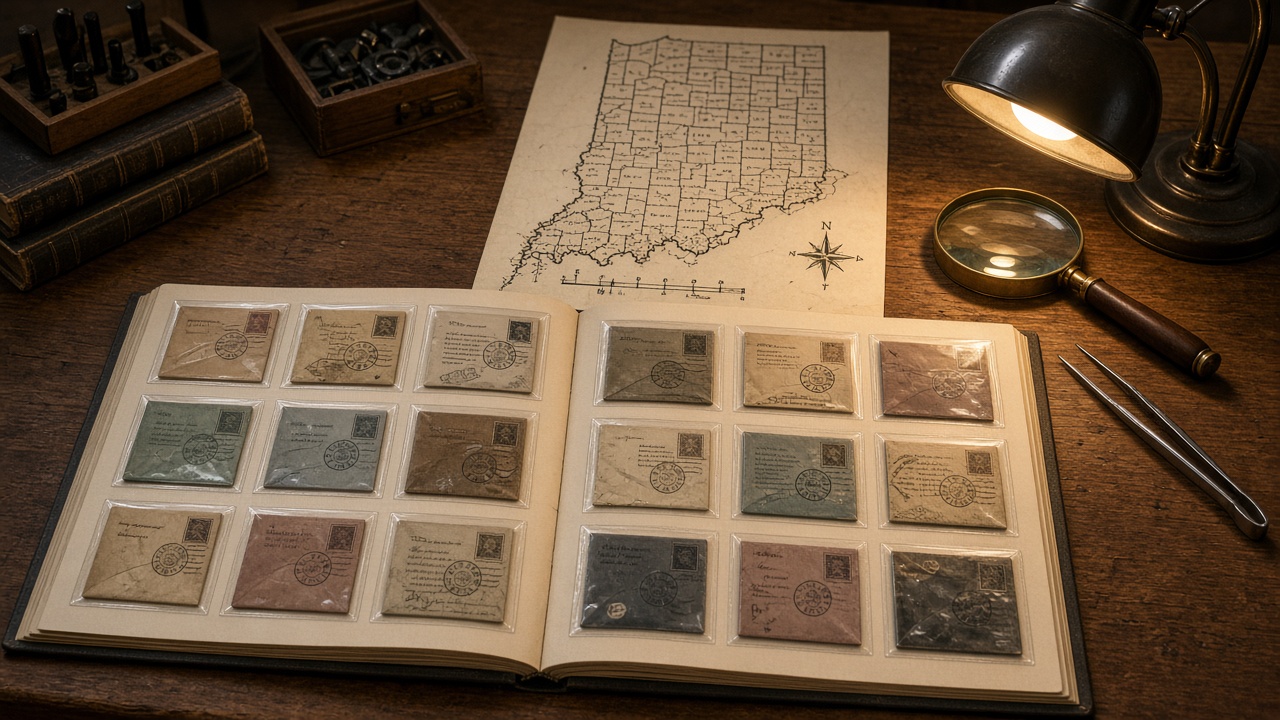
You do not need much equipment. A 5x to 10x magnifier, a bright desk lamp that you can angle across the surface, and a notebook will cover most questions. Raking light, which skims across the paper at a low angle, shows whether ink sits on top of the fibres or has been pressed into them. A small ruler lets you measure the diameter of a circular datestamp, a detail that often helps you match a mark to a known handstamp.
Read the town, state and date
Begin with the basics. Which town and state are named in the ring? Is the year shown, or only the month and day? Many nineteenth-century datestamps omit the year entirely, which means you must infer it from the stamp, the rate or the letter inside. Write down exactly what you see before you start interpreting it. Letters can be unclear on a weak strike, and a first impression recorded in pencil is better than a memory.
Confirm that the office existed
Indiana had thousands of post offices over the years, and many were open only briefly. Before you accept a postmark, check that the town had an office on that date. Reference works on Indiana post offices, state and county histories and the records held by the National Archives and the Indiana State Library can all help you confirm opening and closing dates. If a postmark claims a date after the office closed, or before it opened, that is a serious warning sign.
Compare the mark with the stamp
The stamp and the postmark must make sense together. Compare the date of the postmark with the period when that stamp was on sale. A stamp used before it was issued cannot be right. A stamp used long after its issue is possible, especially when old stock was used up, but it deserves a second look. Check also that the rate paid matches the postage in force at the time and the weight or class of mail.
Look at the ink and the strike
- Colour. Black was the usual colour for most of the nineteenth century, but blue, red and other colours appear at particular offices and periods. An unusual colour is not suspect by itself, but it should match what is known for that town.
- Edges. A genuine handstamp strike has slight irregularities: uneven pressure, a heavier side, a filled-in letter. A mark that looks perfect and uniform on every example may be a modern reproduction.
- Overlap. A real cancel usually runs over the stamp and onto the envelope. A neat postmark on the cover that stops precisely at the stamp's edge, with no ink across the perforations, should make you pause.
- Ink behaviour. Under magnification, old ink should look settled into the paper. Ink that sits in glossy beads or smears when lightly touched is a concern.
Turn the cover over
The reverse often supplies the proof. Receiving marks, transit stamps and railway or route-agent markings add independent dates. If a letter was mailed in a small Hoosier town and received two days later in a distant city, the two marks should agree with the known train or stage schedules. When the back is blank and the front is perfect, ask why.
Common red flags
- A rare or popular postmark on a plain, low-value stamp, where the combination seems designed to attract buyers.
- A postmark and cancel that do not share the same ink colour or age.
- Signs that the stamp has been moved from another envelope, such as glue residue that does not match the paper.
- A cover that looks too clean for its age, with no folds, toning or handling marks.
Record what you learn
Keep a short record for each cover: the town, the date, the stamp, the rate, the ink colour, the diameter of the mark and where you bought it. Over time, your own records become a reference that you can use to compare new purchases. When in doubt, ask a specialist society or an experienced dealer, or consider a certificate from a recognised expert service for any expensive item.
Careful reading will not make every cover a treasure, but it will help you avoid costly mistakes and enjoy what you own. A postmark that checks out on every point is a satisfying thing: a verified moment in the life of a Hoosier town.